
Diabetic Foot Care Clinic (DFCC)
What is DFCC: A specialised clinic within the CIIVES Department, focused on preventing and treating diabetic foot complications
Who Needs It: Anyone with diabetic neuropathy, poor circulation, a non-healing ulcer or a history of foot complications
Core Focus Areas: Nerve function, blood flow, skin integrity and foot pressure distribution
Approach: Preventive screening combined with podiatry and advanced wound management under one roof
What Is Diabetic Foot Care Clinic (DFCC)?
DFCC is the CIIVES Department’s specialised clinic dedicated to preventing, diagnosing and treating diabetes-related foot problems, such as non-healing wounds, diabetic foot ulcers and the complications that follow.
It is built around the two problems that make diabetic feet uniquely vulnerable, nerve damage and poor circulation, along with everything that follows, including ulcers and infections.
- Focuses specifically on neuropathy, poor circulation, ulcers and infections rather than general foot complaints
- Combines routine preventive care with advanced wound management
- Works in close coordination with vascular specialists to restore blood supply to the limb
- Treats early intervention as the single biggest factor in avoiding major amputation
Why Does the CIIVES Department have DFCC?
A diabetic foot problem often starts small: a callus, a blister, a minor cut that goes unnoticed because sensation and healing are both compromised. Left unchecked, it quietly progresses into a non-healing ulcer (or diabetic foot ulcer) or infection and gangrene, which may require amputation.
Diabetic foot ulcers (DFU) affect up to one in three people with diabetes and are the leading cause of non-traumatic leg amputations worldwide. In India, DFUs account for nearly 80% of all non-traumatic leg amputations, making early assessment and timely intervention essential for limb preservation.
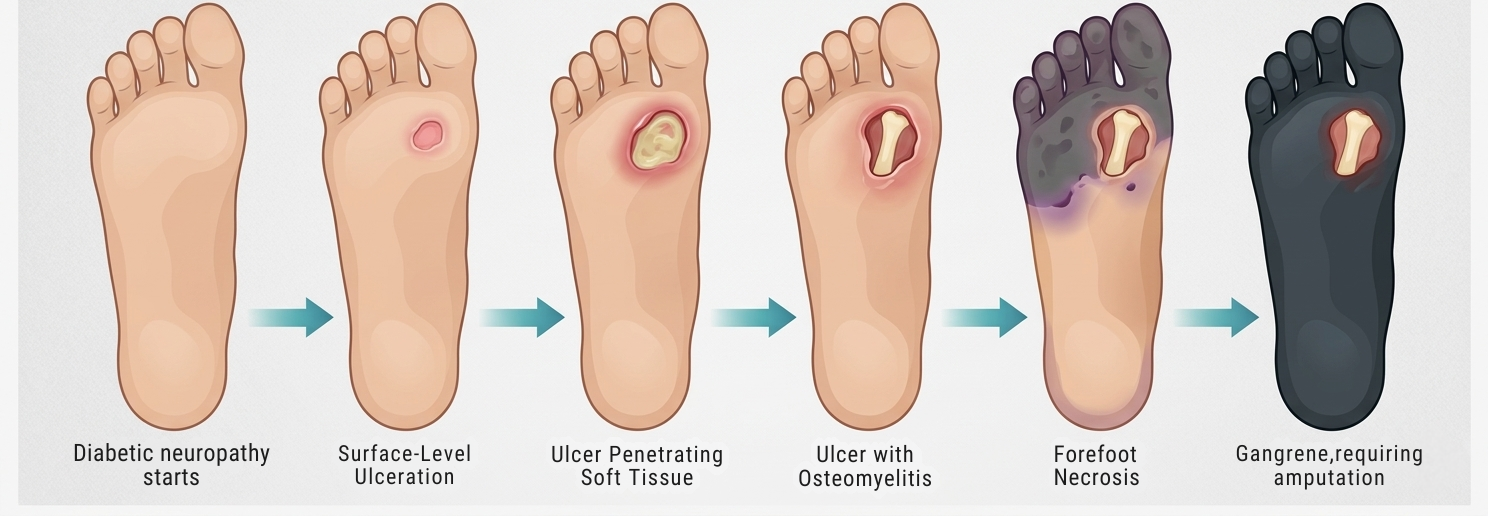
Why Do People with Diabetes Need Specialised Foot Care?
Diabetes Damages Nerves
Persistently high blood sugar gradually damages the sensory nerves running down to the feet, a condition known as diabetic neuropathy.
- Reduces or eliminates normal sensation in the feet over time
- Injuries such as cuts, burns or pressure sores can go completely unnoticed
- A patient may walk on a wound for days or weeks before realising it exists
Diabetes Reduces Blood Flow
Diabetes also accelerates peripheral artery disease (PAD), narrowing the arteries that supply the lower leg and foot.
- Reduced circulation slows down the body’s natural healing response
- Oxygen and nutrients reach the tissue in smaller amounts
- What starts as a minor scrape can quietly progress into a chronic, non-healing ulcer
- Reduces or eliminates normal sensation in the feet over time
- Injuries such as cuts, burns or pressure sores can go completely unnoticed
- A patient may walk on a wound for days or weeks before realising it exists
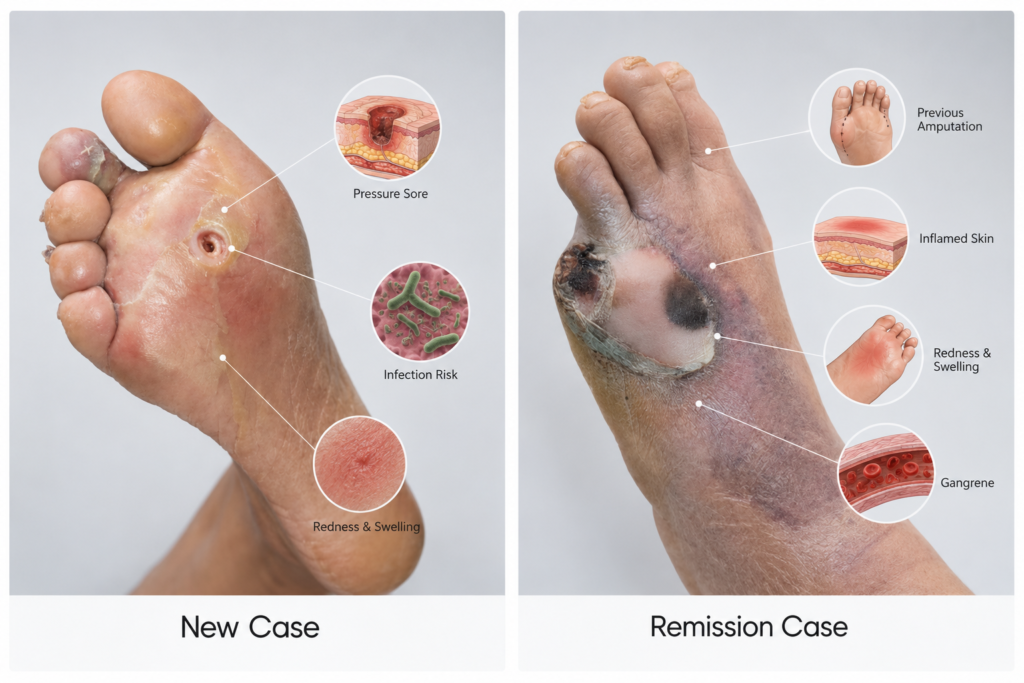
Why Early Treatment Matters?
Because sensation and circulation are compromised, small wounds behave very differently in the diabetic foot than they do elsewhere on the body.
- Delayed treatment sharply increases the risk of infection
- Untreated ulcers can progress toward gangrene if left unmanaged
- Early vascular assessment significantly improves the chances of limb salvage
When Do Diabetic Foot Problems Need Specialised Care?
Diabetic foot problems will require more than routine diabetes management if any of the following signs are present:
What Does Diabetic Foot Care Clinic Offer?
DFCC consultation at CIIVES involves a structured evaluation that looks at the foot from every angle that matters: walking pattern (gait analysis), foot sensation, circulation, pressure and skin health.
Meet The Foot Expert
Dr. Preeti Gupta, the Diabetic Foot Surgeon & Podiatrist at CIIVES, specialises in the early detection, prevention and management of diabetic foot issues.
She performs detailed vascular, neurological and biomechanical assessments using advanced diagnostic tools to identify risks early and guide personalised treatment plans.
Her evidence-based approach focuses on wound healing, limb preservation and helping patients maintain long-term foot health.
Here's what is involved in the DFCC consultation:
Complete Foot Assessment
- Avoid prolonged sitting or standing to improve circulation.
- Daily walking or ‘raise the heel’ exercise to activate the calf muscle pump.
- Healthy weight management & leg elevation can further help relieve symptoms in mild to moderate cases.
Vascular Assessment
These tests evaluate whether enough blood is reaching the foot to support healing, determining whether wound care alone will suffice or whether circulation needs to be restored first.
- Ankle-brachial index (ABI) and Toe-brachial index (TBI): Compare blood pressure at the ankle or toe with the arm to flag blockages, confirms PAD diagnosis
- Doppler evaluation: Checks pulse volume and blood flow at the bedside
- Transcutaneous oximetry (TcPO₂): Measures actual oxygen reaching the tissue around a wound
- Arterial duplex ultrasound: Used when a more detailed map of blockages is required
Neuropathy Assessment
- Monofilament testing to check for loss of protective sensation
- Vibration perception testing for early nerve involvement
- Neuropathy analyser for a more precise, quantifiable reading
- Overall assessment of protective sensation loss, which guides how cautious footwear and activity advice needs to be
Pressure Mapping & Biomechanical Assessment
- Podiostat-based pressure analysis to map weight distribution across the sole
- Gait assessment to understand how the walking pattern affects pressure points
- Identification of high-pressure hotspots before they turn into ulcers
- Planning for custom orthotics based on this dat
Preventive Foot Care
- Safe, professional nail care
- Removal of calluses and corns before they hide an ulcer underneath
- Management of fungal infections
- Practical skin care guidance for daily use at home
Advanced Diagnostic Technology at DFCC
At DFCC, specialised equipment detects early circulation problems, nerve damage, pressure abnormalities and other signs.
ABI Machine: Measures the Ankle-Brachial Index (ABI) to assess blood flow and detect peripheral artery disease.
TcPO₂ Monitor: Measures tissue oxygen levels to assess healing potential and wound viability
Podiostat: Maps plantar pressure distribution to identify high-pressure areas that may lead to ulcers.
Neuropathy Analyser: Provides an objective assessment of nerve function and loss of protective sensation.
Callus Trimming Machine: Safely removes thickened skin and calluses to reduce pressure points and lower the risk of ulcer formation.
Lympha Press: A compression therapy system that helps reduce swelling and improve lymphatic circulation where clinically indicated.
Advanced Treatments Available at DFCC
At DFCC, specialised equipment detects early circulation problems, nerve damage, pressure abnormalities and other signs.
Advanced wound care: Regular debridement, advanced dressings, infection control and moist wound healing techniques to support tissue repair.
VAC (Vacuum-Assisted Closure) Machine: Supports wound healing by applying controlled negative pressure to suitable diabetic foot wounds.
Negative Pressure Wound Therapy (VAC): Controlled suction removes excess fluid, reduces bacterial load and encourages healthy granulation tissue to form.
Offloading footwear: Total Contact Casting is considered the gold standard, alongside removable offloading boots and custom insoles that redistribute pressure away from the ulcer.
Regenerative therapies: Platelet-rich plasma (PRP), growth factor therapy, skin grafts or substitutes and biological wound matrices are considered for select non-healing wounds.
Vascular intervention when needed: Patients with significant PAD may require endovascular or surgical revascularisation first, since without adequate blood flow, even the best wound care has a limited effect.
FAQs
Can a Diabetic Foot Ulcer Heal Without Surgery?
Yes, in many cases. When caught early, diabetic foot ulcers can heal with structured wound care, offloading, and infection control alone, without the need for surgery. Offloading is essential, since a wound that continues to bear body weight will struggle to heal no matter how good the dressing is.
Surgery, especially vascular intervention, becomes necessary when the ulcer is complicated by significant peripheral artery disease. If blood flow to the area is too poor to support healing on its own, revascularisation is usually needed before the wound will respond to any other treatment.
What Tests Are Done in a Diabetic Foot Care Clinic?
A DFCC evaluation typically combines vascular and neurological testing with a hands-on wound assessment. This includes ABI/TBI measurements and Doppler ultrasound to check blood flow, TcPO₂ to measure oxygen at the wound site and a detailed neuropathy assessment to check sensation.
Alongside these, pressure mapping is used to identify areas of the foot under abnormal load, and a direct wound assessment determines depth, infection risk and the right treatment plan. Together, these tests give a complete picture rather than a single data point.
Can Diabetic Foot Problems Be Prevented?
Yes, good glucose control is the foundation, since high blood sugar drives both nerve damage and circulation problems. Daily self-examination of the feet, checking soles, between the toes and around the nails, catches issues early.
Well-fitting footwear reduces the risk of pressure injuries, and a vascular evaluation can detect silent changes in circulation or sensation before symptoms appear. Any minor injury should be treated right away, since “wait and see” is rarely safe for a diabetic foot.